
Affair Nostalgia: When the Past Affair Blocks Healing and Reconciliation
One of the most painful and confusing roadblocks couples face after infidelity is something many people don’t have language for—but feel deeply. It’s called affair nostalgia.
We recently received a listener question that captures this struggle perfectly:
“My husband says the only thing he feels bad about regarding his two-year affair is hurting me. He’s not sorry that he found happiness with his affair partner. I want to reconcile, but if he will always see his affair partner in a good light, I can’t move forward.”
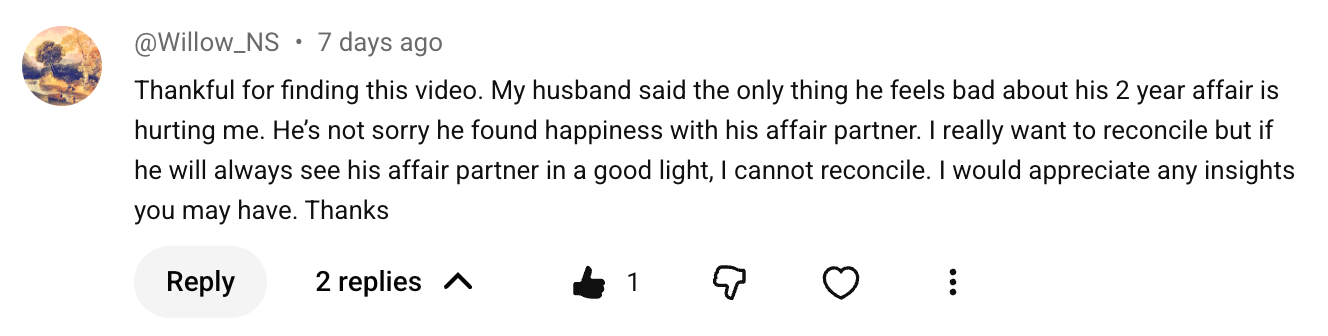
This question touches on a core truth about affair recovery: reconciliation cannot happen when one partner is still emotionally holding the affair in a positive light.
Let’s talk about what affair nostalgia is, why it’s so damaging, how it affects both partners, and—most importantly—what can be done about it.
What Is Affair Nostalgia?
Affair nostalgia occurs when the unfaithful partner continues to idealize the affair or affair partner after the relationship has ended. You may hear things like:
“It meant so much to me.”
“I felt alive.”
“They were so beautiful or handsome.”
“I’m sorry I hurt you, but I don’t regret the relationship.”
While the affair may technically be over, emotionally it is not.
There is little true remorse, minimal empathy, and often no regret for the choices that pulled time, energy, and intimacy away from the marriage and family. For the betrayed partner, this can feel like being cut open again and again.
Why Affair Nostalgia Is So Painful for the Betrayed Partner
After betrayal, one of the deepest emotional needs is the need to feel chosen.
Infidelity communicates, “You were replaced.” Healing requires a new message: “I choose you.”
When the unfaithful partner continues to speak fondly of the affair—or minimizes it—the betrayed partner is left wondering:
“Are you really committed to us?”
“Is your heart still divided?”
“Am I just the safe option?”
Affair nostalgia signals emotional split loyalty. And reconciliation requires emotional clarity. You cannot rebuild safety when it feels like there are still three people in the marriage.
The Emotional Experience of the Betrayed Partner
Many betrayed partners experience a painful internal contradiction:
They deeply want the relationship.
They fear the person they love.
They want closeness—but push it away when it hurts too much.
This creates sadness, heartbreak, embarrassment, anger, and confusion. Many ask themselves, “What’s wrong with me for still wanting this?”
Because there is no clear rulebook for betrayal, people oscillate between hope and despair. One moment they look for reassurance—small signs of warmth, affection, or effort. The next moment, anxiety spills out as criticism, demands, or emotional withdrawal.
This isn’t weakness. It’s trauma.
But unfortunately, these understandable reactions can trigger a negative cycle where the unfaithful partner feels overwhelmed, pulls away, and then uses that distance to justify their lingering attachment to the affair.
Why the Affair Can Start to Look “Better” in Conflict
Affairs often function as emotional escapes—from stress, depression, unmet needs, or relational conflict.
When post-affair conversations feel tense or painful (as they often do), the unfaithful partner may unconsciously retreat to the fantasy of the affair. Not because it was healthy or real—but because it felt easier.
This doesn’t mean the affair partner was actually a good fit or that the affair was love. It means the relationship existed in a bubble—free from responsibility, conflict, and real-life consequences.
That fantasy must be dismantled for healing to occur.
The Inner World of the Unfaithful Partner
Unfaithful partners who experience affair nostalgia are often emotionally conflicted.
They may:
Feel genuine guilt for hurting their spouse
Still feel attached to the emotional high of the affair
Stay in the marriage primarily out of guilt, children, or obligation
Feel trapped or annoyed by ongoing emotional needs
The betrayed partner can sense this immediately. Guilt-driven effort feels hollow. It doesn’t communicate desire or choice—it communicates obligation.
Some unfaithful partners also minimize their actions, emphasize their own past wounds, become defensive, or set rigid boundaries that protect their comfort rather than repair trust. These behaviors create new injuries that must later be healed.
Healing Requires a New Marriage—Not the Old One
Many couples say, “I just want things to go back to normal.”
What they usually mean is: “I want the pain to stop.”
But going back to the old marriage will only lead back to the same outcome. Healing after infidelity requires building something new—a new marriage, a new emotional foundation, and new ways of relating.
This is a winding road. Not a straight line.
Affair recovery often starts imperfectly—sometimes motivated by guilt, fear, or practicality. That doesn’t mean it can’t grow into genuine commitment. But it does require intention, patience, and guidance.
What Can Be Done?
For the Betrayed Partner:
Address betrayal trauma directly—this is not something you “think your way out of.”
Get clear on what reconciliation means to you.
Set compassionate but firm boundaries:
“I’m open to rebuilding if you are fully choosing us.”Ask for real remorse—not excuses or half-ownership.
For the Unfaithful Partner:
Get clear on why you are choosing the marriage.
Write down your reasons—motivation grows with clarity.
Actively starve out the affair:
No contact
No social media stalking
No romanticizing
Stop idealizing the affair partner by intentionally acknowledging the full reality—not just the fantasy.
One powerful exercise:
Write 20 reasons you choose your marriage—and 20 negative qualities or realities of the affair partner and affair relationship. This helps dismantle limerence and fantasy.
Healing Requires Cutting Off The Emotional Blood Supply To The Affair
Like starving a tumor, you must block what feeds it so the rest of the body—your marriage, your family, your identity—can heal and thrive.
Affair nostalgia is not a life sentence. It is a phase that can be worked through with the right support, structure, and commitment.
If you are struggling with betrayal, emotional confusion, or lingering attachment after an affair, you are not broken—and you are not alone.
Healing is possible.
And with help, you can build something stronger than what existed before.
