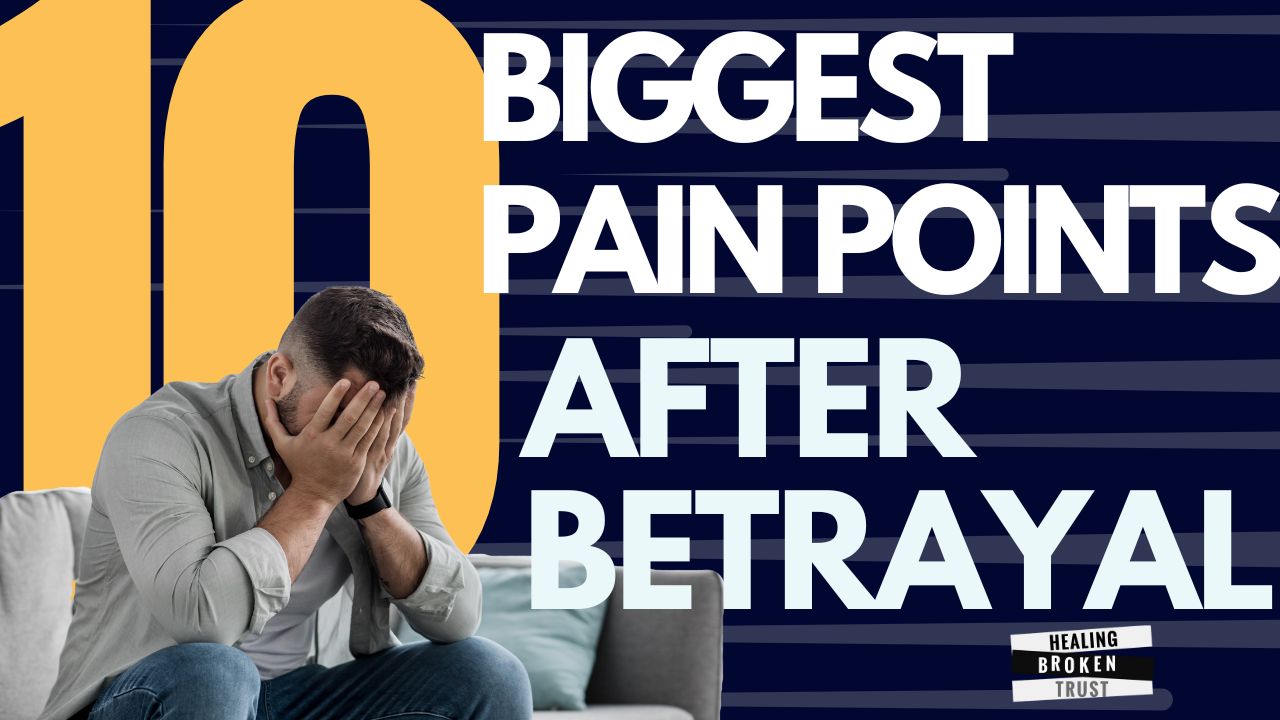
Ep 88 - Healing After Betrayal: Navigating the 10 Biggest Pain Points

Ep 88 - Healing After Betrayal: Navigating the 10 Biggest Pain Points

In this episode, we delve into the profound challenges faced by partners who have been betrayed. Discover the ten most significant pain points that arise after infidelity, from feeling unsafe and grappling with trickle truths to dealing with intrusive thoughts and the loss of self-worth. We share insights and practical steps to help you navigate these emotional hurdles and find a path to healing. Whether you're struggling with anger, grief, or the loneliness that betrayal brings, this episode offers a roadmap to reclaiming your life and rebuilding trust. Join us as we explore the complexities of betrayal and provide guidance for those seeking to heal and move forward.

Ep 87 - Stuck After Infidelity? The Cycle That Blocks Trust Repair

Ep 87 - Stuck After Infidelity? The Cycle That Blocks Trust Repair

Healing after betrayal can feel impossible when couples get stuck in the a negative cycle, where the hurt partner keeps emphasizing how painful and damaging the betrayal was, while the one who caused harm defends themselves through minimizing behaviors like “It wasn’t that serious,” “I had a reason,” or “You’re overreacting.” 

Research shows that perpetrators often downplay harm, while victims naturally focus on the impact—but in strong romantic relationships, victims aren’t always “maximizing” as much as we assume; instead, the biggest problem is often the Distancer’s minimizing, which blocks safety and creates a second injury…. 

Ep 86 - When the Unfaithful Sees the Affair Partner in a Positive Light

Talk to Someone

Transcript:

Morgan (00:03):

Hi, welcome to Healing Broken Trust for Brad and Morgan Robinson, and we have a great show for you today. Actually, we have a listener question that we want to discuss today. The listener says, "My husband said that the only thing that he feels bad about his two-year affair is hurting me. He's not sorry that he found happiness with his affair partner. And I really want to reconcile, but if he will always see his affair partner in a good light, I cannot reconcile." So they would appreciate any insight. And one of the biggest emotional roadblocks to healing broken trust after an affair is something that's known as affair nostalgia. And when the unfaithful partner still holds the affair in a positive light, that can be really hard. So we're going to talk about that, Brad.

PREFER TO WATCH THIS AS A VIDEO? CLICK HERE

Brad (00:53):

Yeah. And that's basically what a fair nostalgia is. It's when the unfaithful partner is held in a positive light. People will talk about, "It meant so much to me. It was so great. I love it. " They're not really communicating any sort of remorse or regret. They're not portraying that they're sorry. Maybe I'm sorry I got caught, but they're not really warm or empathetic, that kind of thing.

Morgan (01:21):

They don't regret. It's almost like they don't have any regret for having the affair.

Brad (01:24):

Yeah. And an example of this could ... There's a lot of different examples of this. One is like the listener question. The affair has been over. He had this two-year affair. It's over, but they're not really even sorry. That could be one because they're still idolizing the affair. Another could be like anytime they talk about the affair partner, they talk about how beautiful the person was or handsome they were. It's like, "Man, this person was so handsome, so beautiful." And it's like, "Oh my gosh, just cut me in a million pieces. I don't need to hear that.

Morgan (01:56):

" Yeah. I'm trying to reconcile.

Brad (01:57):

Yeah. And messages like that, what they create is they really cause people to feel like, "Okay, how serious are you about us?" Because the core need for somebody who's been betrayed is they want to feel chosen after being betrayed. It's like, "Okay, I was replaced. Now I need to know that I'm chosen." And when affair and nostalgia is there, where people have this kind of rosy picture of the affair, that can really make reconciliation hard for the betrayed because healing requires that both of us get on the same page. We got to get the truth out there. I need to know you're sorry, and I need to see a real desire to rebuild something new together with us and not just repair the damage that happened for appearance's sake about what other people think. It's got to be about us and we've got to really roll up our sleeves.

Morgan (02:53):

Well, it also seems very clear and obvious that you can't have a mind for two people, right? It's a heart for two people. It's me only because I'm your beloved. So yeah, it's absolutely a challenge that's hard.

Brad (03:08):

Yeah. Well, that's a good point because when somebody, they're communicating that they're emotionally split. When somebody who's having an affair only feels bad about hurting their spouse, but they don't regret the investment that it took away from their marriage and their family and into the affair, they can be emotionally split. And then that makes it harder to give those things that are needed back into the marriage after the affair.

PREFER TO WATCH THIS AS A VIDEO? CLICK HERE

(03:34):

Usually what people will say who've been injured is they're going to say something like, "You know what? I'm not asking that much. I think this is reasonable what I'm asking for. If reconciliation is going to work, you have to be willing to do these things for me. I need you to take full responsibility. Don't be defensive. I need you to show empathy and remorse, not just for the pain that you caused me, but for the choices that you made. And I need you to let go of idealizing this affair partner." And what that means is I need you to work through those unresolved fantasies or unmet emotional needs that fuel this affair. And I need you to also reinvest emotionally back into our marriage and do that wholeheartedly, not just stay married on paper, but really rebuild something special.

New Speaker (04:17):

That's right.

Brad (04:18):

And this is kind of what else they would say for somebody who's been injured and on the receiving end of that kind of persistent rejection, because that's the other thing, Morgan, that's a part of this, is when the affair happened and then they kind of have a fair nostalgia, it's still rejecting. And so until that happens, somebody who's betrayed in this scenario is going to feel like reconciliation is going to be really hard for them. Even if they desire it and want it, they're going to get stuck in this painful negative cycle of doubt because they feel like, okay, you're still emotionally attached somehow, some way to the affair partner, and that does not create the safety I need.

New Speaker (04:55):

No. Right.

Brad (04:57):

So far we're talking about this from the perspective of the person who was betrayed. We're going to get a little bit, and we're going to explain that a little bit more, but then we're going to get deeper into the perspective of the person who has been unfaithful in how they see this and view this.

New Speaker (05:13):

Yeah.

Brad (05:13):

Do you want to get into kind of how the person who's been betrayed

Morgan (05:19):

Feels? Yeah, absolutely. So the first point would be, the person has strong feelings and really wants a relationship. So the would be lover, the person who likes someone, who doesn't like them back, right? And in a sense, this can go kind of two ways, right? You've got the elements of limerance, right? When someone is kind of pining over the affair partner or what the affair gave to them, they almost have this idealized view of that relationship and of that person. And so they don't have kind of probably a real look at that relationship because it's not true love. It's not real love. It's kind of an idealized perspective of the relationship. And so, but also the person wants, they want the other person to like them back and to choose them.

Brad (06:17):

Yeah. Ultimately they want to be chosen. Both people. Yeah. The affair, when you're in the affair, you're showing you're choosing the other person, you're not choosing me. And part of what people need after they've been betrayed is, "I need to know that you're choosing me for me, not for kids or money or other reasons." You're really here for me. And that's kind of what Morgan is saying is like, "I want this relationship to work, but I need to know that you're choosing me for me. " They want to be pursued. That's right. They see the effort that was put into the affair. They want to see that applied back to them. They want to be pursued as well. And so part of what they can feel is they feel like sad a lot and heartbroken. They feel embarrassed like, "Why am I still wanting this when you don't?

(07:02):

Is something wrong with me? " And then they obviously are going to feel angry about this because it's unfair. It's not what they signed up for. And then they're confused because they don't know what to do next. There's not these ... Nobody really knows what to do in these situations. Everybody thinks they know what they're going to do until it happens to them. And once it happens to us, it's like all bets are off. It's like,

(07:26):

"Okay, we're going to divorce if you ever cheat on me. "

Morgan (07:29):

Right. I hear that so many times.

Brad (07:31):

But when it happens, people don't really know how to work through that and approach that because it's so difficult. And back to your point that you made earlier, Morgan, is there's strong feelings that the person who's been betrayed has, they still want the relationship. The irony is they still want it. Yes, many times they do, but they also are afraid of the person. "I love you, but I'm also angry with you or I need you close by, but when you get close, they push you away. "It gets very confusing for the person who had the affair and that can fuel the affair and nostalgia because, gosh, I'm trying, but it looks like everything I'm doing is just leading to an argument all the time. And so it's like when we don't get along, it makes the affairs seem like it was greener pastures. Even though this person may have had their issues, maybe they weren't that great of a catch.

(08:28):

Yeah, it is something that's unfortunate and I shouldn't have done, but when we don't get along, that's when my nostalgia for the affair partner grows worse. I want that more.

Morgan (08:40):

Yeah. And it does take time for the remnants of the affair and all of that to be put away completely, right? So oftentimes a person has been in this limerance or this outside relationship for quite some time, right? So they've built up all of this kind of world inside of themselves, inside their mind, in their life, like this whole other world, right? And so they're having to dismantle that, right? And it has to be dismantled completely. And so there's going to be those remnants before they completely and fully reinvest in the relationship sometimes. So when you're hearing them say," Oh, the affair was wonderful or that person was wonderful. They shouldn't be saying that because that's detrimental, that's damaging, but when you're hearing that, but they're still with you and they're still wanting to work on the relationship, that's probably the remnants of that affair that is still being dismantled and put away and it does take some time, unfortunately, and it can be very painful,

Brad (09:49):

But

Morgan (09:50):

It's necessary work.

Brad (09:52):

Yeah. Yeah. And Morgan, part of what they can do, the person who's betrayed in these situations where

New Speaker (09:59):

Their

Brad (09:59):

Spouse who had the affair has this affair nostalgia is they tend to think about us. So they're looking for little subtle clues. They're looking for signs like, okay, they were warm today, they smiled at me today, we made love, they were planning a trip. They're looking for little things and they're reading between the lines because they're looking for hope. They want hope that you are thinking of me, that you have changed your mind about this other person.

Morgan (10:29):

Oh yes, from the betrayed partners perspective. Yeah.

Brad (10:32):

Yeah. They want these things, so they replay it. What can happen though is it leads to anxiety and fear. So they look for reassurance. So it bubbles up inside of them where they have all this anxiety and fear, this pressure is mounting inside of them and what can happen is that they then can approach their spouse in a critical way, demanding way, blaming way, which is understandable because it's like, "Okay, you had this affair, you've hurt me, you've destroyed me and now I'm supposed to be a doormat and just like tolerate this.

New Speaker (11:07):

"

Brad (11:08):

So all this boils up inside of them and it's hard to talk about these things in a vulnerable way where they can get reassurance and get clarity, but because they do it in a more critical, blaming, demanding way, that causes the person who had the affair to pull back

New Speaker (11:24):

And

Brad (11:25):

Then it causes them to like, "Oh my gosh, this is overwhelming. We can't make it. See, I knew you wouldn't forgive me.

New Speaker (11:31):

"

Brad (11:31):

And kind of can feed into underlying issues that they had prior to the affair

Morgan (11:36):

Happening,

Brad (11:36):

If there were any. And if that happens, that really causes them to, that can feed that affair and nostalgia. If we don't get along, that can feed this affair and nostalgia. So that's really scary. Yeah,

Morgan (11:51):

That's important.

Brad (11:52):

And it's not saying that to shame anybody or blame anybody, but it's good to be aware of these patterns that may be there.

Morgan (11:59):

Right, because it's almost like a mental, emotional escape, right? The affair is often an escape for someone, an emotional escape, escape from depression, escape from stress, escape from whatever it might have been that was difficult or challenging. And so when things naturally in a loving working relationship, a marriage, oftentimes when things don't look so relaxed, it can be a tendency, a habit, right? Because most of this is a habit, a habitual response, right? And so they go back to that habitual response of exiting emotionally, exiting mentally, and that takes them to kind of the romanticized version of that relationship. And so anyways-

Brad (12:52):

Yeah, Morgan, kind of like piggyback off on that, part of what the betrayed will do in the situation is to try to talk more,

(12:59):

Reach out more, spend time together. They're looking for reassurance. Obviously, we all want it in this kind of situation. They're going to ask for another chance, why not? Maybe they get really angry and say, "Screw it. We're done. No more." Those kinds of ... Maybe they want it, and then they kind of draw a line and say, "I don't want it. " And then they take that back. They withdraw the boundary when it seems like, "Okay, I'm not getting what I want. " They try to really keep the person close even when it can hurt really bad and then-

Morgan (13:27):

And we're still talking about the betrayed partner.

Brad (13:29):

Yeah, the betrayed partner can do those

Morgan (13:29):

Things.

Brad (13:31):

And part of what makes this hard is that there isn't a really clear rule book on how to act or what to say or what to do. So we feel really lost in these situations. And then if other people know about it, like what's going on, like we're separated or the affairs happened, but they're not really owning up to it after they've betrayed us. It's embarrassing. And this kind of feeds into people what people need who've been betrayed is they need clear answers. They need time, they need support, they need ways to heal their self-esteem and feelings after this. And again, like we've talked about before, they really need the betrayer to become a healer, that kind of thing.

Morgan (14:09):

Morgan,

Brad (14:10):

Do you want to get into part of what people who've been unfaithful in these scenarios think? Oh,

Morgan (14:15):

Sure. Kind

Brad (14:15):

Of the scenario, people who have a fair nostalgia after being unfaithful think.

Morgan (14:19):

So if they have a fair nostalgia, right, and they're thinking about this other person and they're kind of pining after that person, what they're wanting is they want the other person really to stop hoping for romance and they want things to feel normal again, right? So we got to get back to that pattern of normal, but positive, right? We talk about negative cycles a lot.

Brad (14:41):

Yeah. And Morgan, that's a really key insight you just said, because they're not saying, "I want in the relationship with us, our marriage, with you. " They're just saying, "Let's not put too much pressure on restarting our sexual relationship, or let's not put too much pressure into us being this perfect couple. I just want us to be good friends, or I want us to just get along. I want us to just not fight. I just want to get to first base before we start having all this emotional investment."

(15:12):

So sometimes they'll come at it like that. And like we've talked about before, the more intentional somebody was with an affair, like they were like, "I'm intentionally going to go cheat. I'm intentionally going to have an affair." Usually people like that are not as remorseful. They have more justifications for doing what they're doing. And so for them, they usually felt like, I'm speaking generally, but usually when somebody feels like a victim, like I was hurt first, I was injured in some key way before I had this affair, they use that as a justification for acting out. I've got this hurt and this injury so they can be more reluctant to enter back into the marriage. They're not as sorry, they're more reluctant and those injuries and hurts sometimes do have to be addressed for them to reenter back into the marriage because ideally we want the person who is unfaithful to be able to be a healer, but if they have been injured, sometimes we have to address those hurts.

(16:09):

Sometimes they are like, "You know what? I don't trust you even though I had this affair and I know you don't trust me now, but I don't trust you either."

(16:17):

So sometimes you have to kind of be graceful on both sides to address that. So I think that's important what you're saying.

Morgan (16:22):

That is very important that I can trust that you'll respond graciously, that you'll give me time to reinvest back in and as I dismantle all of the things that I've been doing or thinking and feeling for the last however long. So that's really important. So how they feel inside, right? So if the portrayer or the unfaithful spouse, they often feel guilty, right? They do feel guilty because they know that they've hurt you, right? As the listener or the viewer was saying, their spouse, their husband feels bad about how the affair hurt them. So they do love their spouse, they do love the listener, they still feel guilty, but then it's that nostalgia piece, right?

Brad (17:07):

Well, and I think it's a good point you're raising because they do feel guilt, but the guilt is usually the only reason they're still trying. And that's what the betrayed picks up on is like, you're only doing this out of guilt You feel all this towards your affair partner, the guilt is keeping the unfaithful party still in the marriage trying, but it's out of guilt and then the person who's betrayed picks up on that and

Morgan (17:31):

It's not

Brad (17:32):

Helping. No,

Morgan (17:33):

No, no.

Brad (17:33):

Because they're not sensing like, "I need you to pursue me. I need you to put that same effort into this. "

Morgan (17:38):

Or that you're fully invested in them. And like we're saying though, that takes a little bit of time as they dismantle what they've had. And so to try to be patient with that, because that does compound the hurt. I know it compounds the hurt tremendously when you hear those things,

(17:58):

But it does not mean that they can't love you or that things can't be fully invested or that they cannot, or that it's not a sign that it's hopeless, right? Because very often people, they'll reenter the relationship or they'll start the healing process, the healing journey for the kids, because they feel guilty, all of those things, that's how they start sometimes. It's how healing starts sometimes, right? But it does end up where you want it to be generally. It just will take time. And so trying to be patient with that. So if the person keeps trying, they might feel annoyed or trapped because they're still trying, but you need things, the person who's been betrayed, you need them to respond appropriately, you need all of these things. And so they might feel annoyed, they might feel trapped. And it's kind of that problem that we have, that negative cycle where we're sort of butting heads in the process of healing, but know that it's not the end of everything.

(19:05):

It doesn't mean that there's not hope.

Brad (19:07):

Yeah. And part of what people who've been unfaithful in this situation will think where they have an affair nostalgia is they will tend to downplay

(19:15):

Their own actions and the consequences of what they've done. They'll look at it like, "Well, yeah, I had an affair." Or they tend to downplay it. There's a lot of different ways they do that, but the key idea is to downplay it. They tend to minimize it. They tend to emphasize their own hurt. They get defensive. All the things that none of it's reassuring, unfortunately, but they tend to downplay it. And part of what they tend to do is they try to maybe let their spouse down gently. They're going to like, "Hey, it's not you, it's me, maybe we've been broken a while, you said a year ago you wanted a divorce before I started this affair, like our kids are older, nobody's going to be upset with us if we divorce." So they're trying to kind of avoid conflict and they even will start avoiding their spouse more because it's just like it's awkward and it does lead to conflict and these arguments and fights and then maybe they develop their own set of rules like, "Don't text me, don't harass me, don't follow me, don't hold me accountable." They start putting down these firm boundaries to the betrayed

(20:25):

Because the betrayed is like, I need-

Morgan (20:27):

Needing these things,

Brad (20:28):

Actually. Well, I need stuff from you, of course,

Morgan (20:30):

Because

Brad (20:31):

My trust is broken, but when somebody who is unfaithful, they may be like, "No, I'm not reachable. You can't reach me. Nope, can't do this. I can't do that. " They're not going to give. And there's a lot of different ways they can do that. Maybe they move out, maybe they get a no number, maybe they're like, "Maybe I'll stay in the other bedroom, but I'm not going to give to the marriage." They just set their own rules. Those kinds of things, when we're supposed to be quote unquote healing, actually can make situations, not worse necessarily, but they create new injuries, more injuries and hurts that have to be worked through because the core is I want to be chosen. And really part of this too is the unfaithful partner also needs to know they can be chosen. You can look over what I've done, you can forgive what I've done, those kinds of things- You can heal from what I've done.

(21:24):

Yeah, you can heal from what I've done. And the more we kind of get caught into this negative cycle that we're talking about today, like how we're trying to present both perspectives on this, how we get caught in that negative cycle, the more we get caught in that those differences that we're presenting,

(21:40):

The more both partners lose hope that anything can change. And there are some clear strategies that can be done in this situation. If you are the person who's been betrayed, you're really going to have to work on the trauma that's here. You're going to have to work on the trauma, you've been betrayed, you're going to have to ... We have resources available that we can help you with. We've created a whole program that can help you with this kind of trauma. You're not hopeless if this is where you're at. In fact, I would consider you normal if this is where you're at. This is a very normal healing situation. So Morgan and I today are not talking about this like, "Oh my gosh, these people are lost and hopeless."

Morgan (22:20):

No, not at all.

Brad (22:20):

No, this is actually normal. It's like you take your car into a body shop and it's like, "Oh my gosh, it's totaled." To them, that's what they're used to working on, not fender benders. We're the same way. If you're a mess and you feel like, "Ali, we suck, you're coming to the right place. We can help you. " So you got to get help with that trauma, you got to get help with those emotional injuries, and you really got to get clear on what reconciliation means to you, like choosing us. And it's like maybe like what Morgan said, like maybe we do start because of our kids or because it's maybe more practical, so to speak, but we are willing and we want to borrow hope to get to that really great relationship that we can be, that maybe we've had in the past. We want to get back to that.

Morgan (23:13):

Right. And again, often I'll hear that while people will say, "I just want to go back to the way we were. I want to go back to normal." And I think what people are really trying to say is, "I just want to heal from this and not have to feel these terrible feelings again." But it's really important to realize that we're not going to go back to the way things were, right? We're not going back to how it was because we'll just arrive to where we are today. Again, it'll just happen. Again, we don't want that, right? That is not the goal. The goal is to have a new marriage, to have a new relationship, to have something fresh and new. And it's going to take some time and it's going to be a windy road. It's not a straight path, right? It's going to have to sometimes require some give and take, right?

(23:58):

So if the betrayer, the unfaithful partner, the partner who stepped out of the relationship, if they are putting up their own boundaries and they're saying to you, "I am not ready to fully invest in the relationship. I'm still thinking and pining over the affair and what it gave to me. " We have to listen to that, but we also have to realize that that's sometimes part of the healing journey, right? Where they're dismantling this, but the more they begin to invest in the marriage, the more they begin to invest in the relationship, even just not moving out, right? The better it will be, right? It'll turn the corner with help. You can't just say, "Oh, I forgive you, " and then continue forward the way you are. Forgiveness alone does not solve the problems, right? We've got to be able to do something completely different, and that's where we step in, right?

(24:55):

That's where the experts step in to help you to do that. But yeah, it's a winding road. It's not a straight and narrow path.

Brad (25:04):

Yeah, exactly. Part of what you can do if you've been betrayed is set a boundary. I'm open to rebuilding if you're fully choosing us. If you're still attached to the affair, I have to step back to protect myself. You can say that without being angry or mean or spiteful. And that's important. But it's important to be able to use our voice to protect ourself.

New Speaker (25:22):

And

Brad (25:23):

Then it's okay to also ask for true remorse. Not, I'm sorry that you feel that way, or I'm sorry that you got hurt, but it's okay to expect true remorse. And if you've been unfaithful in this situation, it's a really good idea to figure out what you want and get clear on why you want. If you're choosing to reconcile, to get clear on why you're choosing to reconcile, write down all the whys. If the more wise you give yourself for accomplishing a goal, the more things that you can write on a sheet of paper on why you want this specific thing, the more motivated you will be. If the affair only gave you like, "I felt good. I felt this intoxication. I felt this infatuation, but that doesn't give you anything else." That's not a strong enough why. So get clear on why you want your marriage and come up with as many reasons as you can to help you get motivated to reconcile.

(26:28):

And then to ultimately be able to be the person you need to be for your marriage, you're going to have to starve out the affair partner. Part of that means you're going to have to not work with them anymore. Also, starving out the affair partner means not looking them up on social media, not ending your relationship with them, but it also means you're going to have to stop idealizing them.

(26:50):

Part of what causes illuminance to grow and this feeling of infatuation to grow is we look at them in a positive light and usually if an affair hasn't gone on that long, and I'm kind of using air quotes on like that long,

(27:07):

It's not a set amount of time for everybody, but usually in the beginning, we tend to see only the positives in the person. And when we are focused only on the positives of that person, we tend to see them, it tends to feed into that affair nostalgia. They had these good qualities, I felt alive, I felt this, I felt that. And when we feed into that, when we only see the positives and we idealize them, I don't see any negatives, it's going to be harder for us to look at that as a regrettable event. We're going to look at that as like, "Man, that was so good. Gosh, I wish I had done a better job of maybe hiding it. " Maybe that we don't go to that extreme, but what we need to do is kind of look at this and we really have to stop idealizing the person.

(27:57):

So on another sheet of paper, so the first sheet, we have 20 reasons why I'm choosing my marriage, like why I want this. The other sheet of paper, we have 20 bad qualities of the affair partner and then we let ourselves think about those things because the more we can think about that and call attention to that, we stop idealizing it. We stop looking at it as a good thing.

Morgan (28:19):

That's right. Yeah. I think the image that comes to my mind is, if you're trying to starve out a tumor,

(28:25):

Trying to starve out a tumor, you've got to cut the blood supply that goes to that tumor that continues to pump it with nutrients in life or you got to starve it off, put that stent in, block off the blood supply and kill that tumor so that the rest of the body can grow and thrive and function. And that tumor is just a blood sucking leech literally, literally, and it gives you nothing. It's just there and it'll be dead weight until you cut it out and then the rest of the body can thrive. And that rest of the body is your marriage, it's your relationship, it's your family, it's your identity, it's who you are. And that's provided that both partners and the relationship are of course thriving and doing their best to heal and can continue forward better than ever, right? So that's the goal.

(29:14):

And anything else you'd like to add to that or anything? No. Okay. Well, we're so thankful that you're here. We're thankful to serve you, to listen with you and to talk with you about these things. If you are struggling to heal Broken Trust, we are here to help you. You can find us at healingbrokentrust.com. We have programs, therapy, workshops, all of the things to help you. It's a holistic approach, a full approach to healing

(29:45):

The trauma, the marriage, the infidelity to wrap it up, to heal it and to move forward stronger than ever before. So you have a thought?

Brad (29:54):

Yeah. I was just going to say we would love to meet you guys, to meet

Morgan (29:57):

You in person.

Brad (29:58):

Part of what we all offer as opposed to couples therapy or marriage counseling is our programs are very structured. We focus on the key result areas. We focus on those 20% of things that give you the 80% of the results so you can work through this in max quickest time possible and you can do this. Absolutely. We know what we're doing. You need help. Let us help you. And you guys can do this. Absolutely. You can work through this.

Morgan (30:27):

Have you been wondering how to break free from the affair once and for all? Now's the time to take back your life, your emotions, find happiness, joy, and fulfillment with your marriage. Healingbrokentrust.com is the place where you can find resources to take the healing journey to the next level. You'll find incredible resources for every stage of your fair recovery journey. Connect with our team of qualified affair recovery therapists who stay current with the ever growing, ever changing a fair recovery research that's available to help you heal whererever you are in the process. Take our home study course focused on helping you communicate and express yourself in a way that gets you what you want. You can also book an incredible one-on-one intensive retreat where instead of dragging out the pain over months or years, you can condense the time it takes to heal in just a matter of days using scientifically proven methods that work to help couples lower their guard, let go of the fear, melt the anger, and experience each other at a deep emotional level you may have never experienced before.

(31:37):

So what are you waiting for? Go to healingbrokentrust.com, but don't take our word for it. Read the client letters and listen to the reviews on the healingbrokentrust.com website. So go to healingbrokentrust.com and we'll talk to you soon.
Schedule A Discovery Call And Talk To Us About Your Situation


Ep 85 - Why You Haven't Rebuilt Trust Yet

Talk with Someone About Your Situation

Transcript:

Morgan (00:21):

Hi, welcome to Healing Broken Trust. We're Brad and Morgan Robinson. And today we are talking about the process of repairing trust and we just want to jump right in. So Brad, let's talk to them about repairing trust.

Brad (00:33):

Yeah. There's a pattern that researchers have identified or a process that researchers have identified that helps couples repair trust. And it's a research-based model. It explains why just apologizing often doesn't do the work, the deeper work that people need to build trust. And the big idea is that trust repair is not a one time ... Or excuse me, trust repair is not a one person project. It's not just up to one person to rebuild trust. It's actually a two-way back and forth process between two people. That's what they discovered.

(01:09):

And like we've talked about before, there's research on what they call the victim perpetrator dynamic. One person gets wronged, the other person did the offense, but it's up to both people to repair a trust. So on one side is the person who was hurt and whose trust was violated. In the research, they call this the trustor. We're going to use our normal language around that instead of saying trust her. But it's the person who was ... So on one side is the person who was hurt and whose trust was violated. And then on the other side, Morgan, is the trustee. That's the person who caused the damage or is accused of causing it. So you have the truster, the person who broke, the person who was injured, whose trust was violated. And then you have the other person obviously who caused the damage or at the very least has been accused of causing that damage.

(02:00):

And what this model says, this process says is that it says something really important. Trust gets rebuilt when the person who caused the damage or is accused of causing it makes efforts to prove they're trustworthy that outweigh the injured person's hurt, that outweigh the injured person's hurt and their natural drive to protect themselves. So that's really important. And that right there is where a lot of breakdown happens is, okay, you've broken my trust, but your efforts aren't outweighing my fear of getting hurt again. Your efforts are not outweighing the hurt that has happened to me. And when we can't even get past that level, we're not going to get it where we need to go because I'm hurt and injured and you're not putting in the effort that tells me I'm safe enough yet. I'm scared. I don't know what's going to happen. And I'm not seeing the kind of effort I need that you're willing to do whatever it takes.

(02:59):

That tells me, okay, I can relax with you. I don't have to be careful. So in other words, after a breach, a person who's hurt isn't neutral. Their mind and their body are often saying, "Don't be vulnerable again until you have a reason to be safe, until you have a reason to be vulnerable with this person."

(03:19):

So there's resistance and they're not trying to be difficult, but that resistance that they have is self-protection.

Morgan (03:26):

Right. Great. So that's why there's really got to be both people coming together to build and rebuild the trust, not to put the onus on the person who's been hurt. That's not the idea. It's really more about that person being aware of their pain and their hurt so that they can respond to the efforts of the person who violated the trust. Is that pretty fair to say?

New Speaker (03:55):

I think so. Yeah. I would say that's

Morgan (03:57):

Great. A good accurate assessment.

New Speaker (03:59):

Yeah.

Morgan (03:59):

So there were three questions, right? Yeah. Three big questions that were addressed.

New Speaker (04:04):

Yeah. So what they say is that that repairing trust moves through three big questions. You can kind of think of this as stages and which stage you're in determines what kind of repair actually works. So that's really important. So sometimes there's different tools in our tool belt that we can use, but depending on which stage we're in and the repair process determines what actually will stick and will land and be effective. So the first is just the first question that people have is, did you do it? That's the most basic question. Did you do it? Are you guilty or not? That's basically what they're asking. So this is the stage where the person who was hurt is trying to figure out what is true. So, did you sleep with them or not? Was this an emotional or physical affair? How long did this go on?

(04:54):

We're kind of that level where people get caught in those questions. So if the person who's accused can convincingly show that they're innocent or that the event didn't happen the way it's being interpreted, repair is quote unquote easier because it removes the foundation of mistrust. Did you have an affair? Did you not? And honestly, once you kind of get into that realm of like, I'm abandoned, I'm hurt, you betrayed me, there's a real trauma there. But according to the researchers who are applying this, not necessarily to infidelity, but to all kinds of situations, but it gets easier to repair trust if it didn't happen in the way that it's being interpreted. And that's what people will often think who've been unfaithful is like, okay, if it's only emotional, not physical, then that's got to be easier for us. So they'll minimize the lie. That's where trickle truth comes in because it's like, okay, I can't be as bad.

(05:54):

I got to kind of keep water it down, that kind of thing. But ultimately that ends up hurting trust long term

New Speaker (06:00):

Because

New Speaker (06:00):

They're denying and they're lying. And what people need who've been betrayed is like, "I just need the whole truth. I just need the whole story." That kind of thing.

Morgan (06:12):

Yeah. So not dismissing, not minimizing, not lying, so to speak, to make it feel less bad because it's all bad anyways. So might as well just get it out there.

New Speaker (06:22):

Yeah, exactly. And Morgan, here's a key point, and this often gets overlooked. If the person who was hurt is still stuck on, did you do it? And then if we jump ahead to, "I promise I'll change," that kind of promise can fall flat because the person who was hurt is thinking, "Change from what? We haven't even agreed on what happened." And it's like, "What happened here? You haven't agreed on the details." And so there's like a second question that people have. Do you want to get into that one?

Morgan (06:50):

Oh yeah. So why did it happen? So first you've agreed on the details of what happened. You had a one night stand, you were unfaithful five times or whatever it is and it looked like this once that's been agreed upon, the second question then becomes, well, why did it happen? What led to this? If it's clear the trustee or the person accused did it, the next question, was this because of you or because of the situation? So now they're trying to make up and understand why it happened. And so it's where people argue about the cause. The trustor, according to the research, the person who was hurt is asking, does this reveal something about your character and your choices or was this driven by pressures, context or a breakdown in judgment?

New Speaker (07:42):

So I think it's important what you're saying, Morgan, because the person who's injured, they're asking why. And literally everybody who's been betrayed is asking the same thing like, why? What is the cause of this? Is it your character? Is it your choices? What was going on? Is

Brad (07:56):

There

New Speaker (07:56):

Pressure? What was the context around this? And sometimes people who've been betrayed blame themselves, sometimes they don't, but they're looking for a reason. And ironically, people blaming themselves for this helps them actually feel in some ways empowered after a trauma because it's like, if I know the reason for this and if it's me, then I'm not as-

Morgan (08:19):

I'm in control.

New Speaker (08:19):

I'm more in control of

Morgan (08:21):

It.

New Speaker (08:21):

And I'm not saying that to blame somebody for being betrayed like, "Oh, you did it or it's your fault." I'm just explaining how it's normal for people to wonder why did this happen. And if they can't find a cause, they'll blame themselves. And even if they do have a cause, they'll still blame themselves because doesn't mean it's true. It's just a defense mechanism to try to take some degree of control over this. And at this stage, Morgan, the person who caused the damage often tries to explain, "Well, here was what was happening. I was overwhelmed. I wasn't thinking clearly." They'll blame it on circumstances, they'll provide justifications for it, but the person who's hurt what they're hear is more excuse making.

Morgan (09:03):

Yeah, what they hear. Yeah.

New Speaker (09:04):

Yeah. And that really is a huge breakdown, especially when we get into the area of apologies or we get into the area of just letting the person who's injured talk about their feelings around it. People will quickly try to explain themselves thinking that, "Well, if you understood where I'm coming from and you understood my thought process around this, then you could..." At that point, you wouldn't feel bad because you would understand the real reason behind it.

Morgan (09:32):

Or take a target off my back.

New Speaker (09:34):

Yeah, take a target off my back. But it comes across as defensiveness. It comes across as counter attacking, maybe even blaming. We just get into a negative cycle around it and it weakens the trust rebuilding process. So the person who's been hurt when we hear things like, "Well, here was what was happening, so you have some context or I was overwhelmed, I wasn't thinking clearly." When that happens, people will feel like they're just hearing excuses. So this stage is delicate. Explanations can help if they build clarity and the person who's taking ownership as they do it, but they often backfire if they sound like they're dodging responsibility, which is usually what happens, to be honest. I would say 5% of couples get that right where the person who's unfaithful isn't dodging responsibility, they take ownership. And part of that's there's intense shame. They remember the event differently.

(10:32):

They have some of those things that we've talked about before.

Morgan (10:35):

Yeah, absolutely. And so the third question, do you want to jump into it or do you want me to do- You go ahead. Okay. So that third question would be, well, can you change? It's very important. Can you change? So if it's accepted that the violation reflects on the trustee, the person who caused the damage, then the big question becomes, is this fixable? Is this who you are or is this something that you can change from or we can change from? And this is where trust repair becomes about the future. We're looking towards the future and us together, potentially staying together and working this out. And so the person who was hurt is basically asking, "Can I believe this won't happen again?" Is there a real correction happening or am I signing up for repeat harm? Are you going to do this again? Is this going to be a pattern?

(11:25):

Is this going to be who you are?

New Speaker (11:29):

Exactly. Yeah. And that's really important.

Morgan (11:31):

Yeah.

New Speaker (11:32):

That question of can you change? So we go from, did you do it like yes or no? Did you do it? It's kind of black or white to why did it happen? And then ultimately, can you change? And you know what's interesting, Morgan, is that usually people who've broken trust ask themselves the same questions. They're not asking did I do it. They know if they did it or not.

Morgan (11:55):

Usually.

New Speaker (11:55):

Yeah. Unless they're like blackout drunk or something, but they are asking, why did I do this and can I change? Most people are good. If they've broken trust, they don't want to do it

Brad (12:06):

Again.

New Speaker (12:06):

Even if they're really mad at their spouse, they felt like it was justified, that kind of thing. As some of that kind of wears off, some of that anger wears off and some of those justifications wear off that we've talked about already, they are wondering like, "I don't want to do this. Can I change? I want to be a good person. I want to live by my values. Why did I do this?

Morgan (12:30):

" I want to have true love. Yeah, I want

New Speaker (12:31):

To have true love. Real connection. Yeah. They don't want to be kind of the villain in their own love story. And so what you're saying is important at this stage, so at this stage, what matters most isn't just words. So there's the question of, can you change? And usually there's promises, yes, I can, I won't ever do it again, that kind of thing. But what rebuilds trust is evidence over time.

(12:56):

Things like changes in behavior, transparency, accountability, putting safeguards in place, boundaries in place, and then just having consistency from the person who caused the damage. A breakdown that occurs here is when the person who broke trust is arguing about the kind of boundaries that are in place. They're like, "I don't want this kind of boundary put on me. I can't do that. That's too much. You're asking too much of me. " That kind of thing. And part of what needs to happen is what needs to happen is they got to just keep showing I'm willing to do whatever it takes. I can change. I'm willing to do whatever it takes, but they got to do it in the key result areas. And the two biggest areas to prevent future infidelity are going to be having healthy boundaries in place because negative boundaries or poor boundaries, I mean, give rise to opportunity.

(13:52):

A lot of the people who stray usually have poor boundaries. They share things that belong in the marriage with others. They can have people pleasing tendencies, people who get drunk or on drugs. Those are poor boundaries just because you're high. But the other area is they got to do what's called proximity seeking, meaning they got to learn to lean on their spouse emotionally when they're struggling. And what they normally do is they tend to bottle things up and they don't lean on their spouse emotionally. So if we can kind of get really good at both of those, like boundaries and then lean on our spouse emotionally, we're going to be more likely to be faithful in the future. And what's ironic about that is that a lot of people who stray don't feel like, "Yeah, I can lean on you emotionally. I just broke your trust.

(14:40):

I hurt you. I betrayed you. " So now they have a better reason for not being vulnerable and not doing proximity seeking so they have a better reason for doing it. But the irony is that they're still engaged in the same behavior that made them vulnerable and fair to begin with.

(14:57):

And that kind of behavior of like not using my voice, doing proximity, seeking, leaning on my spouse emotionally, what it does is when I don't do that, it creates resentment because things on my end don't get prepared. I'm not having that healthy conflict sometimes that needs to happen.

Morgan (15:12):

And I wonder if people in that position think to themselves, "I can't rely on you emotionally because you're already emotionally so weighted down and heavy and hurting. And for me to come and share how I'm feeling with you is putting more pressure on you than you need right now." But it's the opposite very often. It's very much like it would calm and keep those fears at bay for the person who's hurting because you're becoming more transparent. You're actually someone that they can trust a little bit more because you are relying on them for your emotional needs. And so it feels kind of like the opposite, but it really isn't. It's truly something that's necessary.

New Speaker (15:56):

Yeah. Yeah, exactly. Morgan, there are specific reasons why apologizing isn't enough. Now again, this model of trust for building isn't necessarily talking about infidelity. It's talking about kind of relationships in general, but we can learn from it. There's still insights we can glean. And one of the things they say in this research and this model is that apologizing is often too simple. And I would say, yeah, absolutely. In cases of infidelity, it's often too simple. That's why it doesn't work because it's just too complex of an injury. When an apology is happening at ... Apologies are usually reserved more for that level three where can you change? Usually apologies work better there because they're the person ... What apologies are saying is that I'm taking responsibility and I'm changing. This isn't going to happen again. Kind of like we talked about before where apologies are like an explicit promise like, "I'm not going to do this again." When somebody apologizes and says, "I'm sorry," basically they're kind of saying, "I'm not going to do this again." And that's usually kind of reserved more for that level three, "Can you change?"

Brad (17:08):

So

New Speaker (17:09):

That's why the apologies are more effective in that area, not necessarily when we're explaining why it happened. If the person who was hurt is stuck in, "Did you do this or why did you do it? " And they're trying to figure out what happened or why it happened, then that apology usually won't land because it doesn't answer that person's real question they're having. You're not addressing the actual thing they're bringing up.

New Speaker (17:32):

You're

New Speaker (17:32):

Trying to talk about something else, not what's really there. So congruency is important.

Morgan (17:37):

You got to meet them where they are. Yeah,

New Speaker (17:38):

You got to meet them where

Morgan (17:39):

They're at. The process. Yeah.

New Speaker (17:40):

Yeah. That congruency is really important. Now, some betrayals are going to be harder to repair because there's a question of like, is it integrity or just this is how the researchers define it. Is it integrity or competence? So a key insight from this paper is that not all trust violations are equal. Some are mainly about competence like, did you make a mistake, you messed up, you weren't capable in that moment. Was it a one night stand? Were you drunk? Was it a moment of weakness or was it more intentional? Were you coerced? How long did it last? That might be something. Was it a brief affair or was it a long affair? Was it just messages? Was it maybe was it this or was it that-

Morgan (18:24):

People you're with or ...

New Speaker (18:26):

Yeah. And so did you make a mistake? Did you mess up? Were you not capable in that moment? Those are often easier to repair because improvement is easier to believe. To believe.

New Speaker (18:39):

Right.

New Speaker (18:39):

And that's important.

New Speaker (18:40):

Yeah.

New Speaker (18:41):

But violations that hit integrity, like honesty, faithfulness, moral character are harder because negative integrity information tends to weigh heavier and stick longer. So if I get information about somebody or if I'm married and okay, you cheated on me, you betrayed me and I'm getting information that this is about your integrity and your moral character, that's going to way harder than like if it's just like a other mess up.

Morgan (19:05):

Because it speaks to the core of the person and who they are. And if that's who you are at the core of you, you're just someone who loves to be unfaithful or it's just who you are, then it's going to be a lot harder for someone to believe that you can change or that you want to change, that change is possible. But I would argue that most people are not like that in the sense of like they don't necessarily want to be unfaithful. I mean, I'm sure that people are out there, but most of the time people do want to have a good, loving relationship.

New Speaker (19:41):

Yeah, exactly. Morgan, one of the other things that they mentioned is that what does not help trust building is mixed messaging. So mixed messages can backfire. So there's certain repair attempts that can make things worse. And when there's mixed messaging where the person who is accused denies that they did any wrongdoing, but then they apologize for it like, "No, I didn't do it. I'm sorry you feel like I did." Sometimes that actually makes people feel worse or-

Morgan (20:13):

Because you're apologizing for their feelings. You're saying, "I'm sorry you feel that way. I'm sorry that you had that experience." It can say, it really speaks that they're sorry for how you were feeling, that you are responding the way you are instead of being sorry for their actions or being sorry for the hurt that they caused. That's the big reason that makes messaging to be very mindful and careful about how you word and approach your apology is important.

New Speaker (20:46):

Yeah. Now, another type of mixed message is somebody who is saying I'm innocent, I didn't do it. However, if I did do it, this is why I would've done it. No, I didn't shoot on you. No, I didn't have an affair, but if I did, I would've done it because you neglected me and you hurt me and you weren't there and you embarrassed me, but so I have the right to do it, but I didn't do it. Well, that's a very big mixed message and it doesn't fit logically like you're saying you didn't do it, but here's all the reasons you could have done it.

New Speaker (21:19):

Yeah, you should

New Speaker (21:21):

Have. That doesn't make sense. Obviously suspicions are going to go up for the person who's hurt in that kind of situation. That

Morgan (21:28):

Alone would be a pain that would be a hurt.

New Speaker (21:30):

Well, another mixed message that's really common is I care about you, but then when the person who's been injured says, "Okay, here's what I need to make it better." And then the person who's unfaithful doesn't do anything about it. "I need you to set boundaries. I need you to be honest with me. I need you to let me do blah, blah, blah to understand where you're at and how you feel, go to therapy, join Brad and Morgan's program, different things like that. But you're saying you're willing to do whatever it takes, but then you're like, " Nope, I won't do that. "That's a mixed message. "I won't go to therapy. I won't get help. I won't go- I won't do this. I won't do this. " And that just sends mixed messages.

(22:17):

Now there is patterns that people can get into like we've already talked about. The model that we're talking about says that trust repair doesn't only end and quote unquote fixed or not fixed. It can settle into patterns. Sometimes both people push hard where the person who caused the damage pushes for trust and the person who's hurt pushes back and then they get escalated into conflict and it creates escalation and constant conflict when that happens. You also see the reverse. The person who's hurt is like, "No, you're going to do this, you're going to be accountable, you're going to do this need, you're going to meet that. " And then the other person gets their back against the wall and kind of fights back or gets kind of rebellious, so to speak.

Brad (23:06):

I'm

New Speaker (23:06):

Not going to comply, that kind of thing. And the person who caused the damage, sometimes the person who caused the damage, if they don't put in the effort and then the person who was hurt becomes even more sure they can't trust, you get mistrust, confirmation or suspicion hardens. That's a fancy way of saying basically, "I need you to do X, Y, Z for me because I don't trust you and I ask for it to be done and then you don't do it, it actually confirms I can't trust you. I need you to put this boundary into place. I need you to be honest. I need you to choose me. I need you to work hard at this, but then you don't do it. I need those things from me because I don't trust you. But then if you don't do it, it actually confirms, yeah, I shouldn't trust you.

(23:53):

" And that's really hard and sad.

Morgan (23:56):

Yeah, it is. And it's interesting because I often wonder why people would push back when their spouse is wanting them to do X, Y, or Z to rebuild trust and they don't do it. And I usually see that they don't know how to do it and they don't know how to break out of the patterns and they just really need someone to show them.

New Speaker (24:17):

Well, Morgan, yeah, I'm speaking generally, part of why people don't do the work who've been unfaithful is like we talked about earlier, intentionality. Was this act intentional or not? And when people do an act that they know is wrong, intentionally do it and they know it's wrong and they know people are going to get hurt when they find out, usually they have less remorse after the fact. They have less guilt about the act, at least immediately after it's discovered. That doesn't mean it's going to be that way forever. But when people have that lack of remorse and not any real guilt about it, they're going to struggle to comply with the wounded partner's wishes. They're going to be like, "Why?" "No, I'm not going to do that. "Because part of this, like we've talked about in our podcast, you have to address the underlying negative cycle that's there because if we don't address the negative cycle that we're in, we're healing with a negative cycle.

(25:16):

And all of these things that we're talking about today that are like mismatches are all examples of trying to heal with a negative cycle. And part of what we've created with our program is we help you get out of your negative cycle so you can actually heal. Otherwise, you're healing with the cycle that was in place most likely when this was created.

Brad (25:36):

I

New Speaker (25:36):

Had a couple recently and they were talking about their negative cycle and they're like, " Yeah, we've had this negative cycle for 30 years and then trust is broken, there's an affair and now they're trying to heal from an affair with that same pattern. And sometimes people will temporarily get better after an affair gets discovered, but then that power of the pattern that they've been in, the bad habits that they've had begin to suppress their good intentions and good efforts. And they just get stuck in this. It's a mess.

(26:07):

"So here's what you can do with this information. One practical takeaway you can take from this is which of these three questions are we actually fighting about? Is it, did you do it? Probably we're probably past that. Some of you may be kind of there. Sometimes people listen to our podcast because they suspect somebody has been unfaithful, but maybe we're kind of past that like, " I know because I caught them right-handed, I seen the text messages, I have proof, so maybe we're past, did you do it? "But then there's also the question of why did it happen. We go really deep in our program on why an affair happened. We talk about the 10 characteristics that the average person who has us strays, we go deep into that, which is really eye-opening. And when people see that like, " Oh my gosh, I have these characteristics.

(26:55):

"And probably about 90% of people would say," Yeah, I have all 10 of these. "When people see that they have those characteristics, they are motivated to change because they don't want to be the same person. They're motivated to be a healer, they're motivated to change who they are because they're like, " Crap, this didn't happen in a vacuum. I have real things I got to change about myself. "And then the last ... Yeah, go ahead. The

Morgan (27:17):

Beautiful thing about that is it is changeable. There is hope, which

(27:21):

A lot of people, they get stuck thinking," Oh no, they get stuck in that can't you change mode, right, which is the next one that, oh gosh, this is who I am. I can't change who I am. I just have these desires and things like that. "But that's not reality. Reality is that change is the only thing that's inevitable in life, right? We're all changing, we're getting older, we're everything. So this can change. You can change and life can be better because of your self-improvement. So did you do it that phase? Why did it happen? And then can you change? Yeah.

New Speaker (27:59):

Yeah. And Morgan, the best repair attempts really depend on which question you're answering

Morgan (28:04):

Because

New Speaker (28:05):

You want to be congruent with where you're at.

(28:09):

Sometimes you don't want to have those repair mismatches. The biggest repair mismatch is what we started with this morning. It's this idea of the person who's been injured, they have a real concern on, is this going to happen again? Everything that we've said today, like, can I trust you? Do I mean anything to you? Do I matter to you? They're scared of trusting and they need the person who hurt them. They need the unfaithful party's efforts to outweigh their fears. So if you think about it on a scale, they need the unfaithful party's efforts to outweigh on a scale to override their objections so that they can really heal. Because if they don't sense that the person who's been unfaithful is willing to do whatever it takes, they're like, " No, this is going to happen again. "Is it true that once a cheater, always a cheater?

(29:05):

Is this going to happen in our case? I don't see you trying. I don't see the effort happening. And so they need to see that kind of effort. And then part of it too is like they need to see you growing in the right areas. So part of what we did at Healing Broken Trust is we created a comprehensive program that helps us as a couple, but also helps both partners and their individual needs to heal from this and to really not have this happen again. So if you're interested in that, please call our office. We would love to talk with you and see if you're a right fit for our program. Thank you for joining us today.

Morgan (29:42):

Yeah. And you can also reach out to us at healingbrokentrust.com. That's healingbrokentrust.com. And we'd love to partner with you and help you to heal in whatever relationship that you are in, you can absolutely have a beautiful man Marriage. Yeah. All right. Thanks

New Speaker (30:02):

Guys. Thank you guys. Thank you. We would love it if you're able to like and subscribe if this has been helpful for you. Oh. Yeah. So I'd love to see you guys address identity collapse splitting eraser as it relates to infidelity. Yeah. That's really important because identity is related to memory and if we part of the betrayed their identity, how they view these things gets wrapped up in that and how our identity also shapes what we remember. So for people who've been unfaithful, they can have an identity collapse where they don't remember certain things because it's a mismatch to who they say they are, who they believe themselves to be. And that can lead to compartmentalization. So yeah, really good question.

Morgan (31:01):

Yeah. Okay. Yeah. And I'm trying to think, but any other questions or anything? Any follow up questions maybe? We're so glad that you guys have joined us. We look forward to talking with you again next week. If you'd like to be reminded of these lives, definitely like and subscribe and you can also join our email list when you go to healingbrokentrust.com. If there's not any other questions, we'll call it a day.

New Speaker (31:43):

Yeah. Thank you guys for joining us and listening.

Morgan (31:45):

Yep.

New Speaker (31:46):

We appreciate you. Thank you. Bye-bye. Bye.

Talk with Someone About Your Situation

Ep 84 - Why Isn’t the Unfaithful Sorry for their Affair? Why Can’t They Show Remorse?

Ep 84 - Why Isn’t the Unfaithful Sorry for their Affair? Why Can’t They Show Remorse?

They're often more likely to apologize when they think what they did was unintentional. So we're going to get into some of this research on how they figured this out. So when people feel like what they did was unintentional, they're more likely to apologize. So that's actually really important because guilt is what drives apology. So if I feel guilty, that's why I'm apologizing. That's right. And guilt can be blocked by defensiveness, rationationalizing or shame when the betrayal involves deliberate choices. So the injured partners often thinking, "You chose this, so own it, repair it. Why won't you do this? It makes them angry like you do something about this.

Ep 83 - Why Do We Remember the Details So Differently?

In this episode, Brad and Morgan Robinson delve into the complex dynamics of memory and betrayal in relationships. Discover why both partners remember infidelity differently and how these memory gaps can impact healing and reconciliation. Explore the roles of victim and perpetrator, and learn about the psychological and emotional processes that occur after trust is broken. With insights from historical truth commissions and personal anecdotes, this episode offers valuable perspectives on navigating the aftermath of betrayal. Whether you're seeking to understand your own experiences or support a loved one, this episode provides essential tools and strategies for healing broken trust.

Ep 82 - Handling Triggers As A Couple Especially During the Holidays

Pre-Assurance: How to Create Safety Before the Trigger

Pre-assurance is reassurance given before fear, suspicion, or pain takes over.
It’s one of the most powerful trust-repair tools after betrayal.

At its core, it says:
“I see you. I’m here. You matter.”

Not after they’re activated.
Not when things blow up.
Before…

Ep 81 - Surviving the Holidays 10 Strategies After Infidelity

Transcript:

(00:01):

Hi, I am Brad Robinson, and today I'm going to talk with you about 10 things that we can do to be supportive of the betrayed spouse during the holiday season. As you may already know, navigating the holidays after infidelity can be one of the most emotionally charged in vulnerable times for couples. That is especially true for the betrayed spouse. Holidays are often packed with emotional triggers like memories, traditions, family dynamics, social obligations, and on top of all of that, there's this pressure to be joyful, to have your act together, to act like nothing's wrong in your life, that you're perfect for the unfaithful partner. This is a powerful opportunity to show up emotionally, not by fixing everything, but by being present and by being proactively supportive. I want to go over with you today 10 ways that we can navigate infidelity during the holiday season. 

(01:01):

The first is start with a holiday checking conversation. This is something that you want to do before the season starts or before you go to Thanksgiving at a family member's house or before you welcome guests. You want to have a checking conversation before Christmas, before the holidays that you may celebrate, and the conversation may go something like this. The holidays are coming up and I want to make sure we approach them in a way that supports you. Are there things you're worried about that might be triggering? Is there anything you'd like to skip, change or do differently this year? Many betrayed spouses feel like they have to fake their way through traditions that may feel tainted. Asking that and giving that by being proactively supportive, you're giving them permission to rewrite the script on how things should normally go. The second way that we can turn our negative cycles into positive cycles during the holiday season is don't assume, but ask what your mate needs. Do they want you to participate in certain gatherings or not? Are there certain songs, locations, or even people that are triggering, do they want to celebrate as usual or do they want to simplify things or try something new? 

(02:18):

So question that you can ask is, what would help you feel most supported this year? What can I do to make this day and this holiday season what you need it to be? What you're trying to convey is that you're making the betrayed spouse's emotional safety, the priority, not social appearances or expectations. The third thing that you can do to turn our negative cycle into a positive cycle this holiday season is offer reassurance before every event. By reassurance, I mean you're being proactively supportive versus reassurance, which is usually something you give after something bad has happened or after somebody already starts to feel bad. We want to give reassurance because that is being proactively supportive. It's letting our mate know, I'm thinking about you. You're on my mind thinking about you. You're important to me, you matter to me. So whether it's a family gathering party or traveling, something you can say before you go is, just so you know, I'll be by your side the whole time. If anything feels uncomfortable, we can step out or leave. Your comfort is more important than anything else. What this gives somebody who's been betrayed is an emotional exit plan. It also reinforces your role as their emotional ally, not someone that they have to manage, and it takes the pressure off of them to feel like they have to manage the situation. 

(03:45):

The fourth thing you can do during the holiday season to turn your negative cycle into a positive cycle is to keep communication open, but not force communication so you can check in gently without interrogation. So you can ask, how are you doing right now? Where are you at from one to 10? I just want to stay tuned in so I can support you. Little questions like that make it easier for people who've been betrayed to speak up without needing to explain or justify their feelings. The fifth thing that you can do during the holiday season to turn our negative cycle into a positive cycle is make room for grief. Holidays frequently stir up sadness, anger, even numbness, even in those moments that seem happy, you can say something like, it's okay to not be okay during this season. You don't have to smile for anybody, especially not for me. 

(04:42):

You can normalize the messiness by comments like that, validate their feelings, validate what they're going through, the triggers, the pain, the sadness, even the numbness, the confusion because people have been betrayed. They may not even know if we're going to have Christmas next year, Thanksgiving next year as a family, other holidays that we may celebrate as a family. Are we going to celebrate those? Are we going to have those and the more supportive we can be available, we can be sensitive, we can be, the easier it is to turn this into a positive cycle instead of a negative cycle. The sixth thing we can do to turn this into a positive cycle instead of a negative cycle is to ask something like this, is there something meaningful we can start this year just for us? Why creating new traditions together matters is that creating new rituals helps rewrite painful associations and it helps the betrayed partner feel more empowered to co-create the future. 

(05:42):

The seventh way to turn our negative cycle into a positive cycle this holiday season is to stay transparent. The holidays are full of extra errands, texts, outings, and parties, which can become trigger minefields. So we want to be proactive. Something you can say to help be supportive of your betrayed partner is, here's what my schedule looks like today. If anything changes, I'll let you know right away. I don't want there to be any doubt or fear that you have. Comments like that, remove secrecy and they show consistent effort to be trustworthy without being asked. The eighth way we can turn our negative cycle into a positive cycle is we can protect the betrayed partner's boundaries with others. So if you're around friends or family who know about the betrayal or worse, maybe they were even involved, don't leave your mate to emotionally fend for themselves. 

(06:39):

Something you can say to other people if needed is this isn't a time or a place for any uncomfortable questions. We're focused on healing and supporting each other. Showing loyalty to the betrayed spouse must be visible, especially in social or family settings where all dynamics are at play. The ninth thing you can do to turn negative cycles into positive cycles is to be ready for flashbacks or mood swings. You might be laughing together one minute and then suddenly the betrayed partner shuts down. That doesn't mean you've done something wrong. It might just mean a memory got triggered. Something you can say is you don't have to explain, I'm here with you. Take the time you need when you've been unfaithful. If you can be a calm presence in those moments, it helps your mate regulate their nervous system. You're showing that they don't have to be afraid. 

(07:33):

You're showing that you're not afraid of their pain. The 10th thing you can do to turn your negative cycle into a positive cycle, this holiday season is end each day with reassurance. Even a 32nd moment before bed can rebuild connection. If you've been unfaithful, you can say something like, thank you for showing up today. I know it's not easy. I'm proud of how you're facing this. I'm grateful we're doing this together. Statements like that help end the day with safety and validation, which are critical for a betrayed partner who may still fall asleep, replaying old memories, may not even be sleeping all through the night, may be triggered easily by all kinds of things. So statements like that. Let them know you're there for them, that you're still there and you want to be there. It can be helpful if the person who had the affair has an attitude of unwilling to do whatever I have to do to help you get better. 

(08:27):

By being emotionally supportive, by being proactive, by just being present, I'm willing to show you that I'm willing to do whatever it takes. That attitude can change everything, and these are 10 ways for people who've been unfaithful to show that attitude to the betrayed partner. I want to segue, if you'll stay with me for a few more minutes on how our program at Healing Broken Trust differs from normal marriage counseling. What we offer in our program is a clear plan versus usually what marriage counseling offers is no plan. At Healing Broken Trust, we show you exactly what to work on first, second, and third, and typically, couples therapists don't have a clear plan for these kinds of situations. Part of what we do at Healing Broken Trust is we focus on the 20% of actions that drive 80% of the results. However, most therapists are generalists. 

(09:23):

They're not infidelity experts. They often treat it as equal to other issues couples face, which just retraumatizes the injury partner. What we offer is a process that is focused and fast. Many couples say they've made more progress with us in a few days than in months or even years of couples therapy. What often happens in counseling is that weekly long hour sessions with no clear structure often means couples just vent without fixing the real problems or experts in healing. Infidelity versus general help that you may get in a couple's therapist office. Unfortunately, many couples therapists just treat betrayal like a normal marriage problem, but it's not in healing. Broken trust. We've helped thousands of couples compared to other couples therapists, and normally what they try to do to help people work through it is they move them into a process of false forgiveness where they force the betrayed to forgive before they're ready, without any accountability from the person who broke trust or helping the person who broke trust to become a healer that their marriage needs. 

(10:34):

And at Healing Broken Trust, we look at ourselves as the teacher with other couples, therapists being the student. We have taught therapists how to heal couples after Betrayal. They come to us to learn how to do this, so why not learn from the person who trains the people that you would go to for help, especially when your marriage is on the line. If you were dealing with a deadly form of cancer, you would want the best help you could get for yourself or your family member. Your children and your family deserve the best help you can give them. That's what we offer at Healing Broken Trust. I'll see you guys next time. Thank you.